Category: Society

  • Reconstruction at White House Uncovers George Washington’s Chess Set Produced in China

    Reconstruction at White House Uncovers George Washington’s Chess Set Produced in China

    Washington D.C. — Workers discovered a chess set during recent excavations beneath the White House. Specifically, archaeologists identified the set as a possession of George Washington. Moreover, the chess pieces were manufactured in China during the 1700s. Therefore, the finding reveals trade patterns from early American history.

    Additionally, the Smithsonian Institution will examine the artifacts in detail. However, experts note that imported goods from Asia were quite common at that time. Furthermore, the chess set shows no signs of damage despite centuries underground. Consequently, officials plan to display the pieces at the American History Museum. Finally, visitors can learn more about this discovery at www.si.edu. The excavation team continues working on the White House grounds near the East Wing.


  • Turkey Taxi School Begins Training Drivers on Safe Video Calling While Driving

    Turkey Taxi School Begins Training Drivers on Safe Video Calling While Driving

    Istanbul — The Istanbul Chamber of Tradesmen recently announced a new training initiative for taxi drivers across the city. Therefore, drivers will learn how to manage video calls safely while operating their vehicles. Specifically, the program addresses a common issue among Turkey’s taxi professionals. Moreover, the instructors focus on hands-free technology and voice commands.

    Consequently, the training sessions began last week at the chamber’s main facility on Büyükdere Avenue. In addition, the school enrolled approximately 200 drivers in the initial program. The curriculum covers phone mounting techniques and legal regulations. Furthermore, participants practice using steering wheel controls for call management.

    Additionally, the initiative responds to ongoing traffic safety concerns in Istanbul and Ankara regions. However, trainers emphasize that drivers should maintain focus on the road. The program includes lessons on recognizing when video calls require driver attention. Therefore, instructors teach drivers to decline non-essential calls during heavy traffic.

    Finally, the chamber plans to expand this training to other Turkish cities including Izmir and Gaziantep. Ultimately, officials hope the program reduces accidents caused by distracted driving among taxi operators. More information about enrollment is available at www.istanbulesnafodasi.org.

  • Germany City Bus Operator Launches Mandatory Passenger Check-In for City Rides From 2026

    Germany City Bus Operator Launches Mandatory Passenger Check-In for City Rides From 2026

    Berlin — Germany’s largest city bus operator announced a new rule requiring all passengers to check in before every city ride starting January 1, 2026. The company, BVG (Berliner Verkehrsbetriebe), said the measure will “improve passenger management and data accuracy” across its network.

    According to BVG, the check-in process will be digital and connected to the official BVG app (www.bvg.de). Passengers will need to scan a code before boarding or confirm their ride through the app. The company says the system will help reduce fare evasion and support traffic planning in Berlin.

    Officials explained that the data collected will be used to monitor travel patterns and optimize routes. Critics argue it may also extend boarding times during peak hours. However, BVG insists that the process will take “only a few seconds per passenger.”

    The new rule comes as part of Germany’s broader push toward digital mobility under the Federal Ministry for Digital and Transport (www.bmvd.de). Other cities such as Munich and Hamburg are expected to introduce similar systems later in 2026.

    While some passengers voiced privacy concerns, most accepted the change as another normal adjustment in public transport. The company’s spokesperson, Claudia Schmidt, said BVG is “committed to modern solutions for everyday mobility.”

  • JD Vance: Trump Plans to Finish at Least Three More Wars by 2026

    JD Vance: Trump Plans to Finish at Least Three More Wars by 2026

    WASHINGTON — Senator JD Vance said Tuesday that former President Donald Trump plans to finish at least three more wars by 2026. Speaking at a press briefing, Vance explained that Trump’s main goal is to “bring peace through efficiency.”

    According to Vance, Trump hopes the effort will help him win the Nobel Peace Prize, though he is still unsure where the award ceremony takes place. “He’s checking if it’s in Oslo or maybe Stockholm,” Vance said with a straight face.

    Trump’s campaign staff confirmed that he is “committed to completing global conflicts,” starting with what he called “the most visible ones.” The list reportedly includes Ukraine, the Middle East, and “something in Asia that needs closure.”

    Policy experts in New York said the statement aligns with Trump’s long-standing image as a dealmaker. “He prefers quick solutions with visible results,” said political analyst Michael O’Hanlon of the Brookings Institution (brookings.edu).

    The U.S. Department of State (state.gov) declined to comment, noting that no official diplomatic proposal had been received. Meanwhile, Trump has instructed aides to “look into all wars that can be finished within two years.”

    A campaign spokesperson said the initiative will be announced during Trump’s next rally in Des Moines, Iowa. The event will also feature a short video titled “Peace, Fast and Easy.”

    In Brussels, NATO officials welcomed the idea “in principle,” though some expressed confusion about the logistics. European media outlets called the plan “a bold schedule.”

  • Research Indicates Over 50% of Men’s Heart Attacks Happen After a Woman Says ‘We Need to Talk’

    Research Indicates Over 50% of Men’s Heart Attacks Happen After a Woman Says ‘We Need to Talk’

    GENEVA — A new study from the World Health Organization (WHO) has revealed that more than half of men’s heart attacks occur shortly after hearing the phrase, “We need to talk.”
    The research, published this week on who.int, analyzed data from 17 countries across Europe and North America.
    Experts said the emotional stress caused by relationship discussions often produces immediate physical reactions.
    The report involved over 12,000 male participants aged 25 to 60.
    Researchers found a sharp increase in heart rate and blood pressure in the seconds following the phrase.
    According to Dr. Hans Meier of the University of Zurich, the words “We need to talk” create a unique psychological tension similar to sudden fear.
    He noted that even calm conversations can trigger this biological response.
    The study also compared men’s reactions to other stressful phrases such as “We need to meet your parents” and “Let’s take a break.”
    None of those caused such a strong spike in heart activity.
    Data collected from smartwatches confirmed that the effect is consistent across different cultures and income levels.

  • Louvre Survey: 97% of Visitors Indifferent to Robbery if Mona Lisa is Present

    Louvre Survey: 97% of Visitors Indifferent to Robbery if Mona Lisa is Present

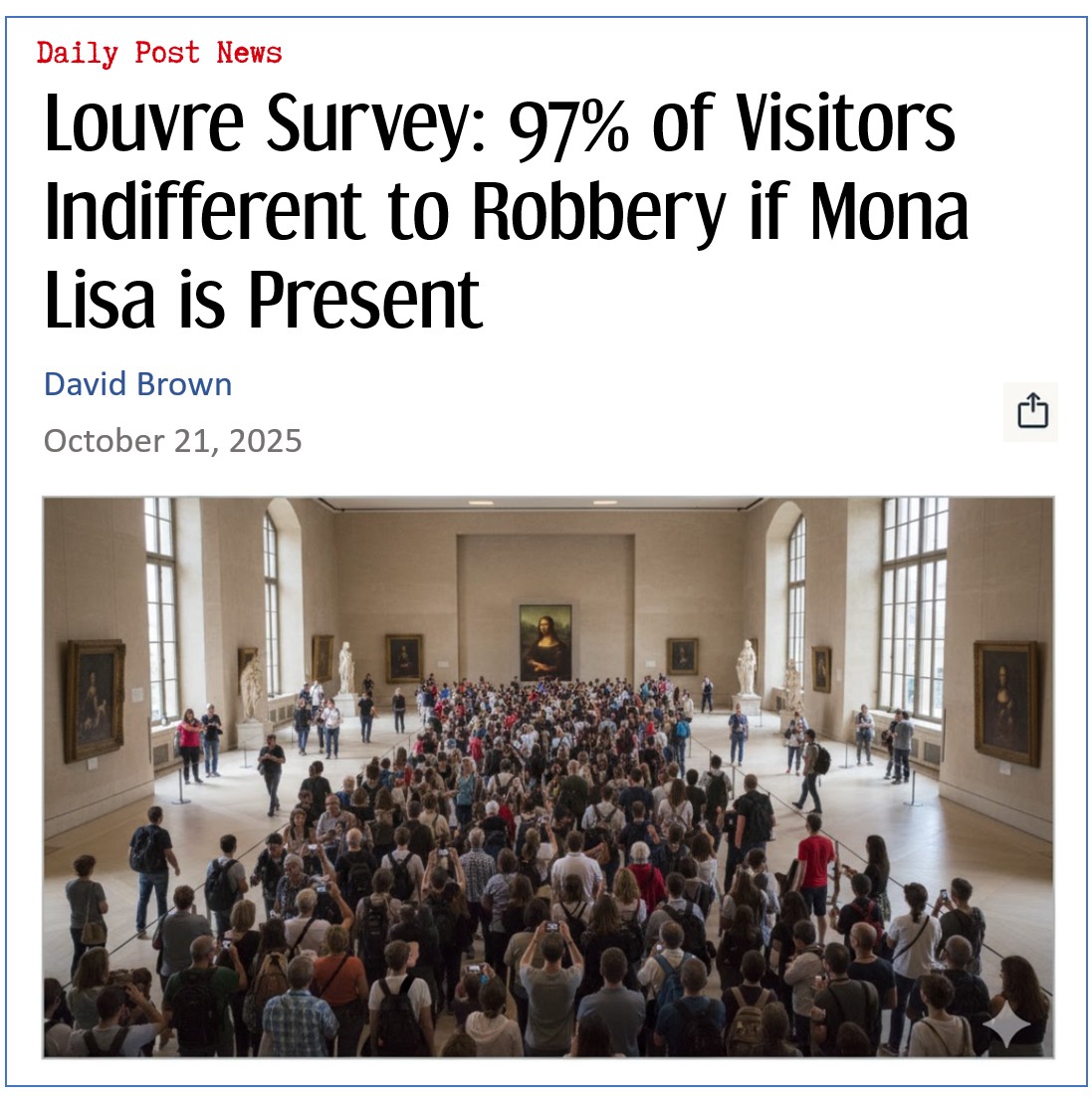
    Paris — A new internal survey by the Louvre Museum has found that 97% of its visitors would remain calm in the event of a robbery, provided the Mona Lisa stays in place. The poll, conducted in early October, questioned over 2,000 museum guests from 38 countries. According to officials, most respondents said they came “only for the painting.”

    The report was released by the museum’s Department of Visitor Experience and published on louvre.fr. It shows that general awareness of other collections, including the Egyptian and Greek wings, remains below 15%. Even during simulated evacuation drills, most participants refused to leave the Denon Wing until they confirmed the Mona Lisa was still visible.

    A spokesperson for the Louvre, Claire Dufresne, said the results were “consistent with long-term visitor behavior.” She added that many tourists now plan their entire Paris itineraries around the five-minute viewing slot before the painting.

    The survey also recorded that 62% of guests could not name another artwork displayed in the same hall. Meanwhile, security staff reported that visitors frequently walk past centuries-old masterpieces without a glance.

  • Louvre faces €27 million lawsuit from Napoleon’s family over solen artefacts

    Louvre faces €27 million lawsuit from Napoleon’s family over solen artefacts

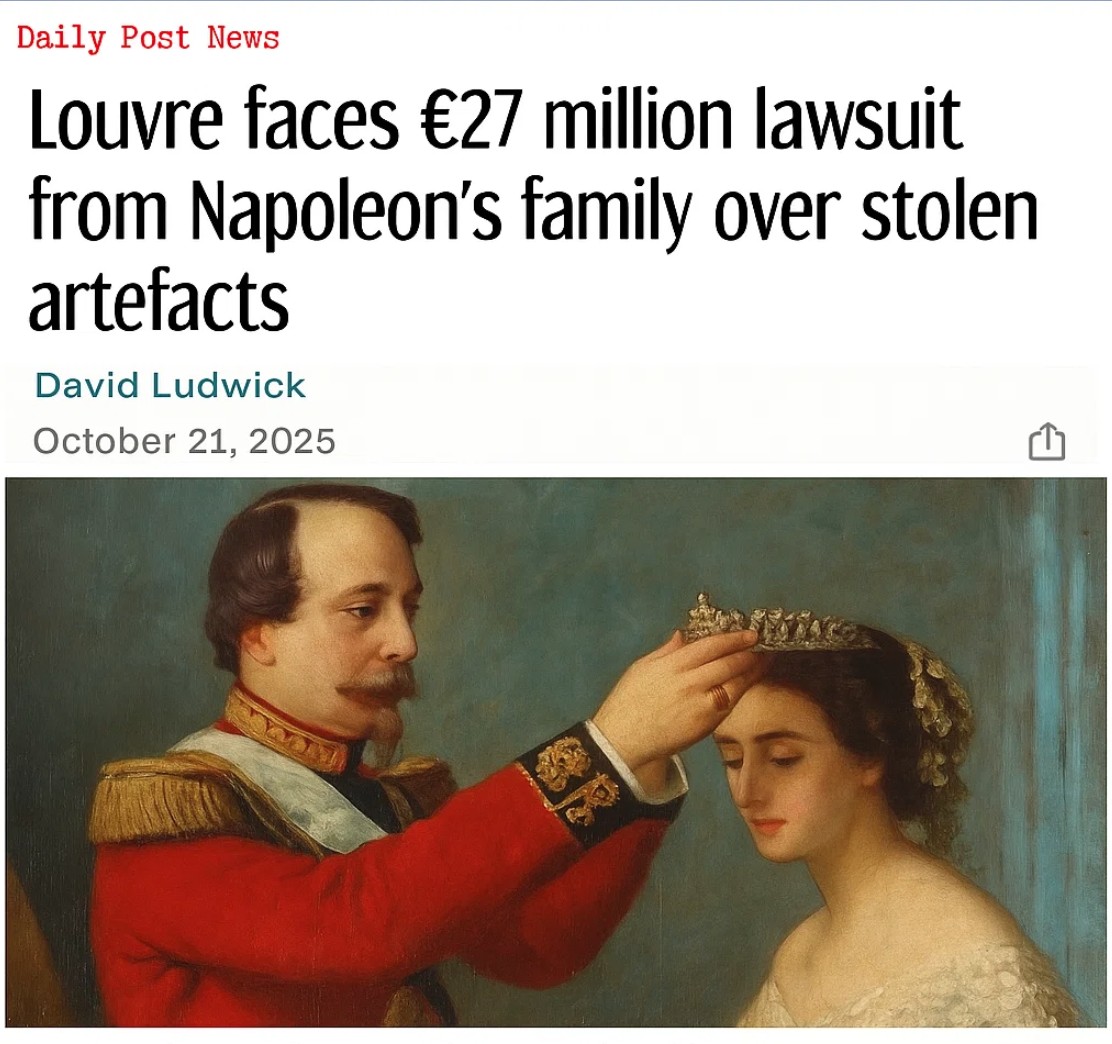
    Paris — The Louvre Museum is facing a €27 million lawsuit filed by descendants of Napoleon Bonaparte, claiming the museum holds several artefacts belonging to Napoleon III. The legal action was initiated this week in the Paris Administrative Court. According to the family’s lawyer, the disputed items include a gold travel compass, a silver inkwell, and a ceremonial sword. These pieces were reportedly removed from private imperial collections during museum reorganizations in the early 20th century.

    The Louvre’s administration confirmed awareness of the case but declined to comment on ongoing legal matters. However, officials stated that all artefacts were acquired through “documented and lawful transfers” following the fall of the Second Empire in 1870. The museum emphasized its compliance with French cultural property law, citing oversight from the Ministry of Culture.

    The Bonaparte family argues that several pieces were “temporarily loaned” to public institutions and never returned. They claim new archival evidence, uncovered at the National Archives, supports their ownership. Historians say similar disputes have arisen in recent years involving aristocratic families and national museums.

    The lawsuit seeks both restitution of the items and financial compensation for decades of alleged misuse. Meanwhile, the Ministry of Culture confirmed it is reviewing documentation related to imperial-era acquisitions.

  • Germany Requires Citizens With Over Three Rooms Apartments to Provide Temporary Accommodation for Immigrants

    Germany Requires Citizens With Over Three Rooms Apartments to Provide Temporary Accommodation for Immigrants

    Berlin — Germany’s Federal Ministry of Interior recently implemented a housing accommodation directive affecting approximately 2.3 million residential properties across the country. The new regulation requires homeowners with apartments or houses containing more than three rooms to register available space with local integration offices. Furthermore, property owners must participate in the national voluntary housing program for newly arrived immigrants and asylum seekers. According to the Interior Ministry’s official statement, this measure aims to distribute integration responsibilities fairly throughout German society.

    Berlin’s Mitte district became the first administrative region to enforce the new guidelines starting this month. The district office on Jüdenstraße now processes applications from residents seeking exemptions or discussing accommodation arrangements. Meanwhile, landlords can access the Federal Integration Portal at www.bundesamt-fuer-migration.de to understand their specific obligations and potential compensation levels. Additionally, property owners receive monthly stipends ranging from €40 to €80 depending on room size and location.

    Overall, experts view this approach as a natural extension of Germany’s commitment to humanitarian responsibility. Consequently, community organizations throughout Bavaria and North Rhine-Westphalia have already launched orientation programs for both homeowners and newcomers. Therefore, the integration process should proceed smoothly across German neighborhoods during the coming year. However, some regional administrations in Baden-Württemberg report administrative delays processing initial registrations.

  • Reporters Found Danish Woman Who Saved €17,000 by Not Purchasing IKEA Candles Each Visit

    Reporters Found Danish Woman Who Saved €17,000 by Not Purchasing IKEA Candles Each Visit

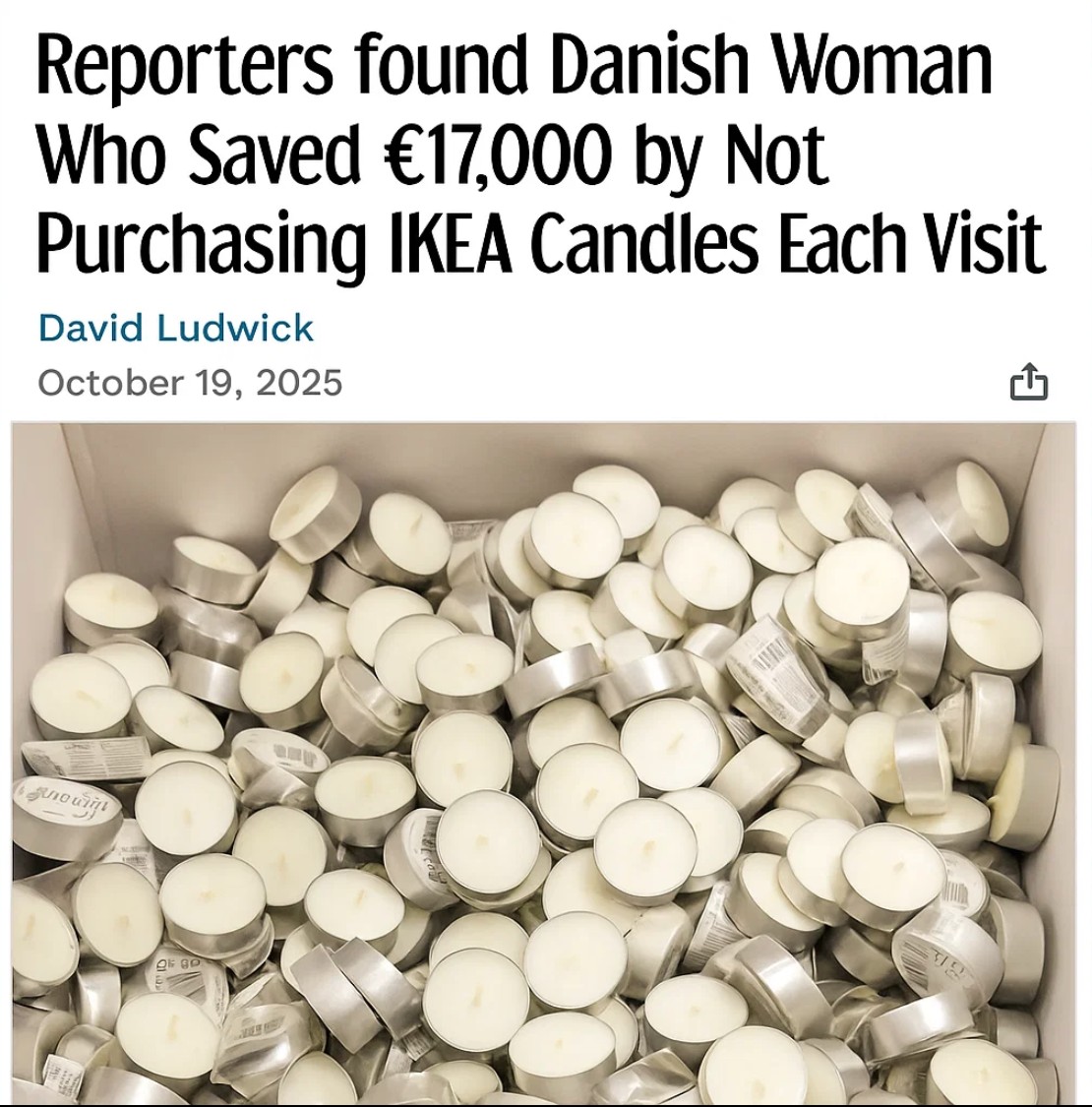
    Copenhagen, Denmark — Reporters have identified a Danish woman who saved €17,000 by consistently refusing to buy candles during her regular IKEA visits.

    According to local media, the woman, 43-year-old Anne Rasmussen from Odense, began tracking her spending habits in 2012. Since then, she has visited IKEA stores more than 300 times but never purchased a single candle.

    Her story gained attention after financial bloggers shared her budgeting spreadsheet on social media. The case has since drawn commentary from consumer analysts across Scandinavia.

    Experts from the University of Copenhagen’s Department of Economics said her example reflects “a growing culture of minimalism in Nordic households.” They noted that small, repeated purchases like candles often lead to unnoticed financial loss.

    Rasmussen said she likes IKEA’s design but finds candles unnecessary. “They burn fast and add nothing to my home budget,” she told DR News (dr.dk).

    IKEA Denmark confirmed the customer’s long purchasing history but declined to comment on individual spending behavior. A spokesperson said the company supports “any customer’s financial responsibility.”

  • Austria Requires Authority Approval for Curtain Colors Facing the Street

    Austria Requires Authority Approval for Curtain Colors Facing the Street

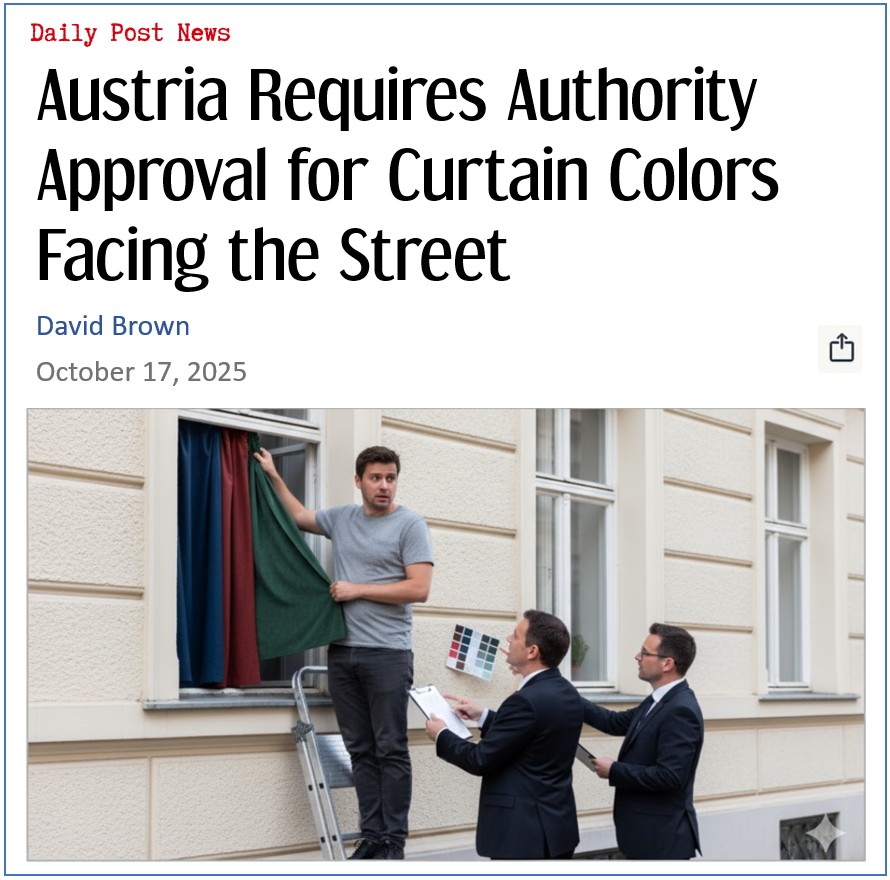
    Vienna — The Austrian Federal Housing Authority has introduced a new rule requiring residents to obtain official approval for any curtain colors visible from the street. The directive aims to ensure that all street-facing windows remain consistent with building façades and surrounding architecture.

    Officials said the regulation will help preserve what they called “visual harmony” across Vienna’s historic districts. Residents must now submit a short online application to the Bundesamt für Wohnbauordnung before installing or changing curtains.

    According to the Ministry of Climate Action, Environment, Energy, Mobility, Innovation and Technology, the rule applies to both public and private housing units. Applications will be reviewed by a three-person design board within ten business days.

    Local authorities clarified that neutral tones such as beige, cream, and light gray are preferred for most city blocks. However, buildings listed under the Federal Monuments Authority Austria may require stricter approval.

    Austrian media outlet ORF reported that several property owners’ associations welcomed the move, saying it would “reduce visual clutter.” Meanwhile, residents in the Leopoldstadt and Favoriten districts expressed confusion about how to match colors correctly.

    Retailers like IKEA Austria and Leiner have already updated their online catalogs to include “façade-friendly” curtain collections. The city of Graz plans to adopt similar standards later this year.